A Step-by-Step GuideFor Groups Led by: Imam Muamar Dahnoun & Ustadh Hassan Masood
Detail
tap for full guide →
Learn the framework here. Live the experience there.
3 Pillars3 Wajibat10 Sunan6 Steps
The Three Parts of Umrah
Like any act of worship — Pillars, Wajibat, Sunan
Knowing which acts are non-negotiable, which are obligatory, and which are recommended tells you what your Umrah requires versus what makes it complete.
Pillars · Arkān
3 acts
Absolute must. If missed — there is no Umrah.
Ihram
Tawaf
Sa'i
Wajibat
3 acts
Obligatory. If missed — Umrah valid, but a sacrifice (fidya) is owed.
Ihram from miqat
Shaving / trimming hair
Following ihram restrictions
Sunan
10 acts
Recommended. If missed — Umrah still valid, no sacrifice.
Ghusl before ihram
White ihram
Niyyah & Talbiyah aloud
Kissing the Black Stone
Raml (men)
Idtibaa' (men)
2 rakah behind Maqam
Drinking Zamzam
Du'as during rites
Halq over Taqsir (men)
Your Umrah · Six Steps
Ihram → Niyyah → Arrive → Tawaf → Sa'i → Halq
Step 01
Ihram
إِحْرَام
Pillar 1 · State + Clothing
Enter the Sacred State
"Ihram" — to make something sacred. It refers to both the clothing and the spiritual state of prohibition.
Trim nails & remove unwanted body hair (do before US departure or in Madinah)
Day of: ghusl (full shower) · scent on body, never on the cloth
Men: two unsewn white cloths (izaar + ridaa) + open-top sandals
Women: any loose modest dress · no niqab, no gloves
Once entered: cutting hair / nails, perfume, marriage, marital relations all prohibited
Preparation · do before
Trim fingernails & toenails
Remove unwanted body hair (armpit, pubic) — can be done before leaving the US or in Madinah
Day of ihram: perform ghusl (full body wash)
You may apply perfume on your body — never on the ihram cloth itself
For Men · Two Pieces of Cloth
Izaar (إِزَار) — the lower garment. Wrap around your waist covering the lower body. Secure with a belt or by folding the top over.
Ridaa (رِدَاء) — the upper garment. Drape over both shoulders covering the upper body.
Footwear — sandals or flip-flops that expose the toes, ankles, and most of the top of the foot. No closed shoes or socks.
Footwear · buy before you goCushioned sandals (OOFOS or similar) bought from the US are dramatically more comfortable than the unpadded $25 vendor sandals near the Clock Tower. You'll walk many miles on stone — your feet will thank you.
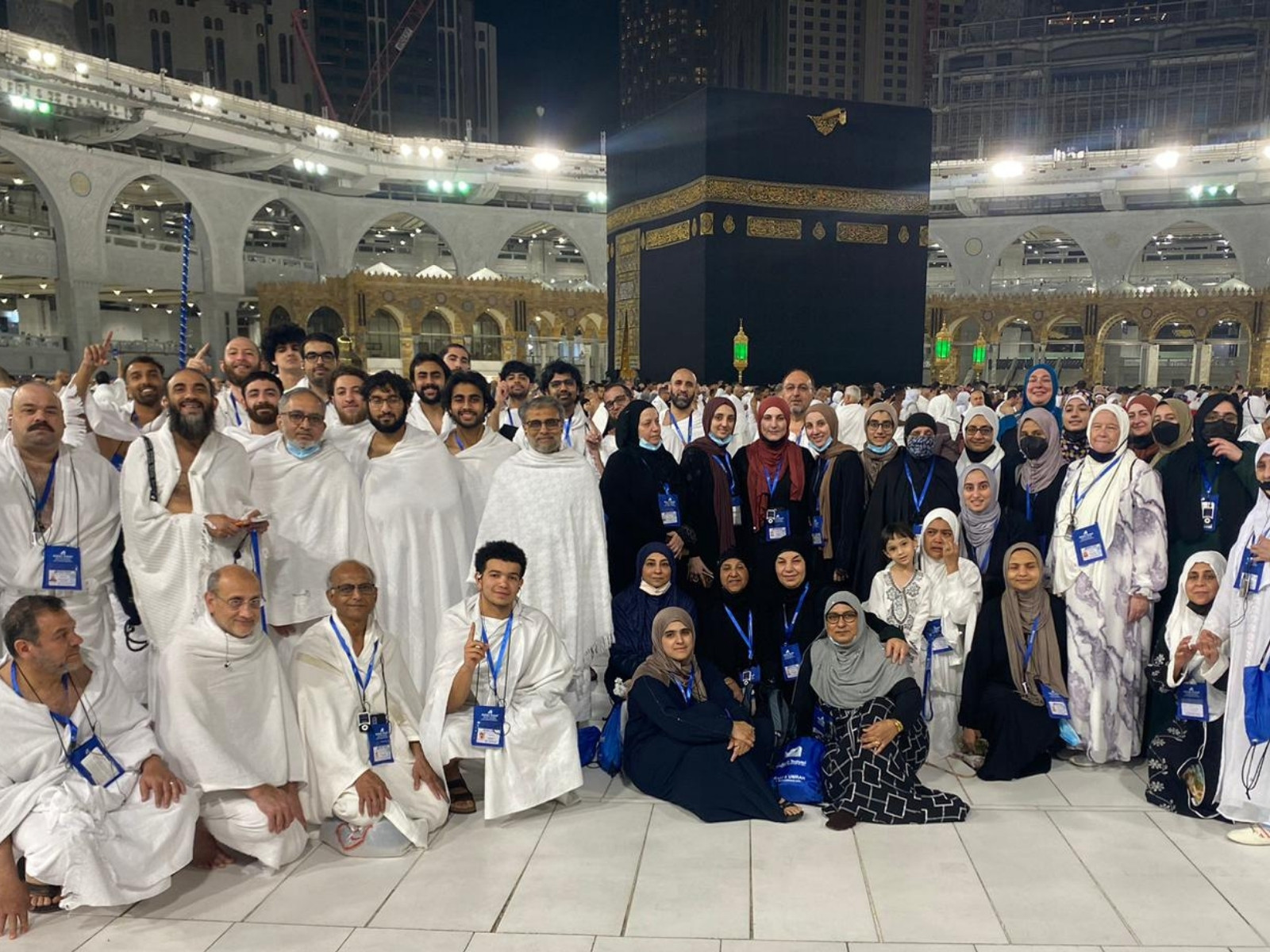
Our group at the Kaʿbah · brothers in two-piece white ihram · sisters in loose modest dress (no niqab, no gloves)
For Women
No specific ihram garment — any loose, modest dress that covers the entire body
Socks and shoes are allowed
Two restrictions: no niqab (face covering) · no gloves
Misconception
"Sewn ihram is forbidden" is a mistranslation. Ihram cloths must be sewn at the edges or they wouldn't hold together. The actual prohibition is on clothing shaped to the body — pant legs, sleeves, fitted tops.
Once in Ihram — Restrictions Begin
No cutting hair or nails
No perfume or scented products
No marriage contract · proposing also avoided per majority (Hanafi permits proposing)
No marital relations
No hunting or harming animals (except dangerous ones)
Men: no covering the head
Women: no niqab, no gloves
Accidents are forgiven
Scented soap by mistake at the train station, hair falling from beard-stroking, a nail breaking on impact — no compensation needed. Medical fragranced cream is also fine. Allah is Ar-Raḥmān.
Step 02
Niyyah & Talbiyah
النِّيَّة وَالتَّلْبِيَة
At the Miqat
Make the Intention · Begin Talbiyah
Intention must be made before crossing the miqat boundary. From Madinah, the miqat is Dhul-Hulayfah (Abyar Ali, ~10mi from Masjid Nabawi).
Before miqat: state intention — "Labbayka Allahumma Umrah"
Add the conditional — "Allahumma maḥillee ḥaythu ḥabastanee"
Recite Talbiyah at least once · keep reciting until tawaf starts
Train PA announces miqat — make intention then
What is Miqat?
Boundary points designated by the Prophet ﷺ. You must enter ihram before crossing one if making Umrah.
Dhul-Hulayfah (Abyar Ali) — pilgrims from Madinah · ~10mi from Masjid Nabawi
Juḥfah — Syria, Morocco, North Africa
Qarn al-Manazil — East: Najd, UAE
Yalamlam — Yemen, south of Makkah
Dhāt ʿIrq — Iraq, northeast of Makkah
By train or air
The PA system announces "passing the miqat" — make your intention then. Logistics workshops cover this in detail.
1 · Declare the Intention (Niyyah)
Niyyah for Umrah
لَبَّيْكَ اللَّهُمَّ عُمْرَة
Labbayka Allāhumma ʿUmrah
Here I am, O Allah, for Umrah.
Doing Tamattuʿ on someone's behalf?
In Tamattuʿ, the Umrah is part of the Hajj — you cannot split them between two people. Both Umrah and Hajj must be on behalf of the same person.
You must have completed your own Hajj first to perform on anyone's behalf. Niyyah at miqat: Labbayka Allāhumma ʿUmratan ʿan [name]. Then on 8 DH: Labbayka Allāhumma Ḥajjan ʿan [name].
2 · Add a Conditional
Say this so that — in case of emergency — you can exit ihram without needing to sacrifice a sheep:
Conditional
اللَّهُمَّ مَحِلِّي حَيْثُ حَبَسْتَنِي
Allāhumma maḥillee ḥaythu ḥabastanee
O Allah, allow me to exit the state of ihram wherever You prevent me.
O my Lord, here I am at Your service. Here I am. There is no partner with You. Here I am. Truly, all praise and provision are Yours, and so is the dominion. There is no partner with You.
Talbiyah is the dhikr of Umrah
Recite continuously — train, bus, walking — until you say "Bismillāh, Allāhu Akbar" at the Black Stone to begin your first tawaf circuit. That's the precise stop. Most scholars consider reciting at least once a wajib.
Step 03
Arriving
دُخُولُ الْمَسْجِد
Approaching the Kaʿbah
Enter Masjid Al-Haram · First Sight
Once in Makkah, take ghusl again if possible. Enter the Masjid with your right foot first.
Enter masjid with right foot · recite the entering du'a
Walk in with head down — group will signal when to look up at the Kaʿbah
First sight of the Kaʿbah is a powerful du'a moment — make du'a sincerely
Aʿūdhu billāhil-ʿAẓīm, wa bi-Wajhihil-Karīm, wa Sulṭānihil-qadīm, minash-shayṭānir-rajīm. Bismillāh, was-ṣalātu was-salāmu ʿalā Rasūlillāh. Allāhumma-ftaḥ lee abwāba raḥmatik.
I take refuge in Allah, the Supreme, in His noble Face and His eternal authority, from the accursed devil. In the name of Allah; prayers and peace upon the Messenger of Allah. O Allah, open for me the gates of Your mercy.
First sighting
An emotional, powerful moment — especially the first time. As a group we'll keep heads down walking into the courtyard so you don't peek before reaching the tawaf floor (ground level / sahn). Then we'll pause for du'a before starting tawaf. Make du'a sincerely — du'as at first sighting are answered.
Group Plan · Timing
If we arrive Makkah late afternoon / evening: group meets in lobby ~10:30–11pm, walks together after Isha when the crowd thins
If we arrive late at night: we accelerate · still wait for crowd to settle
Whole Umrah ≈ 2–3 hours start to finish
You stay in ihram from the train until halq/taqsir — keep reciting Talbiyah
PA earpiece system + blue sticks
Imam carries a microphone. You'll receive an earpiece + receiver — Imam guides each step live as you walk. Two blue sticks mark front and back of the group — stay between them or just follow Imam's stick.
Practical Tips
Mosque is extremely crowded during peak season — stay close to your group
Note landmarks and meeting points in case you get separated
Be patient with crowds — remember the purpose of your journey
First-time wearing ihram and feeling odd? Pray 2 nafl — settles the discomfort
Step 04
Tawaf
طَوَاف
Pillar 2 · 7 Circuits
Tawaf al-Umrah · Circle the Kaʿbah Seven Times
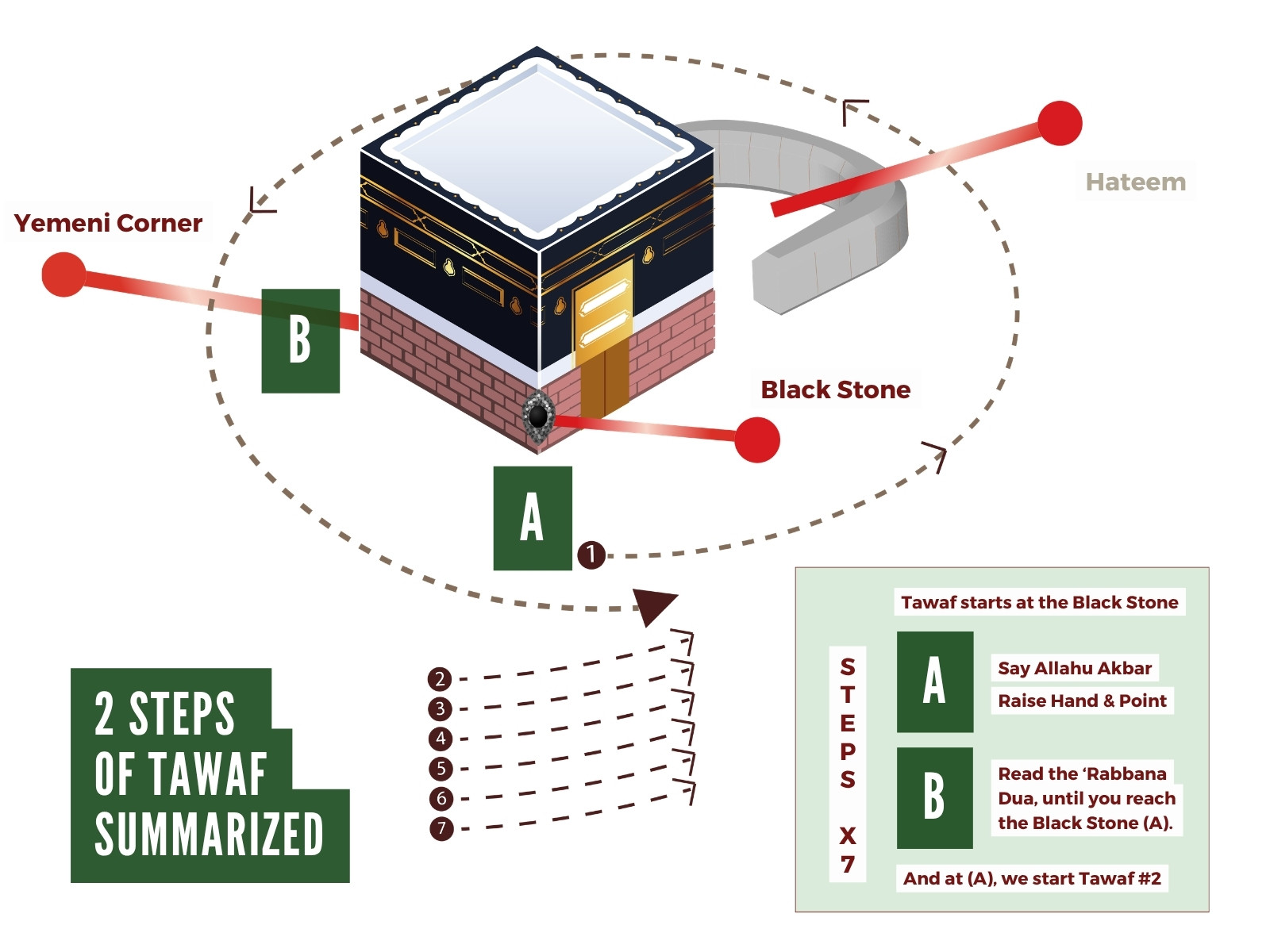
Circle the Kaʿbah seven times counter-clockwise, starting and ending at the Black Stone corner.
Wudu required · 7 circuits counter-clockwise
Start at Black Stone: "Bismillah, Allahu Akbar" — point to it; do not kiss your hand after
Between Yemeni Corner & Black Stone: "Rabbana atina..."
After 7: 2 rakah behind Maqam Ibrahim · drink Zamzam
Men only — idtibaa' (right shoulder out) all 7 · raml (brisk walk) first 3
Requirements
Tahara & Wudu — required for Tawaf according to majority
Men only — Idtibaa' (إِضْطِبَاع): expose the right shoulder for all 7 rounds
Men only — Raml (رَمَل): walk briskly with short steps for the first 3 rounds only. Don't push (you may get pushed)
No specific dua required — make personal du'a, recite Qur'an, do dhikr
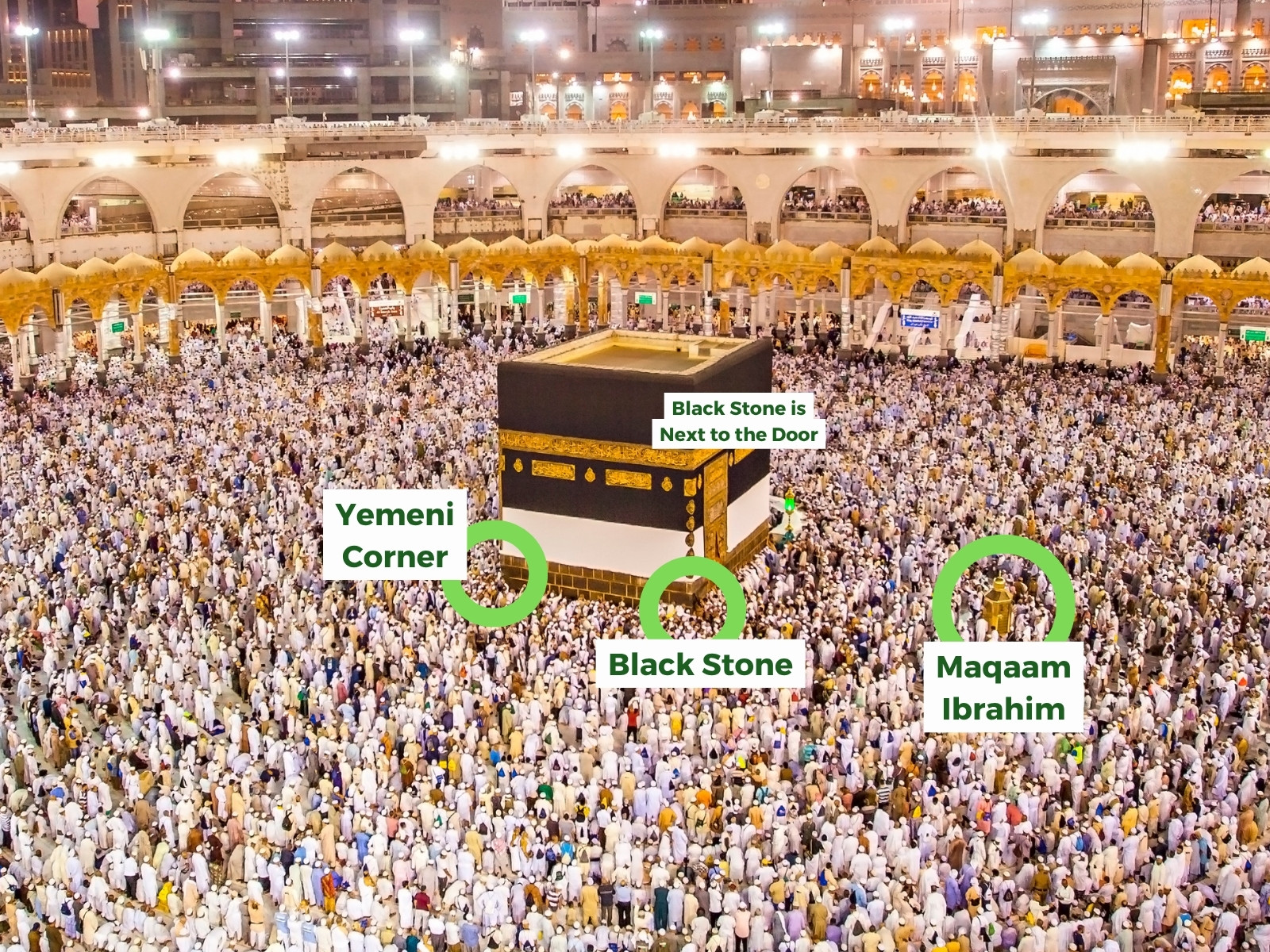
The landmarks · Black Stone (start) · Yemeni Corner (corner before) · Maqam IbrahimThe flow · start at Black Stone → recite the dua between Yemeni Corner and Black Stone → end at Black Stone · repeat ×7
Starting Each Round — at the Black Stone
Face the Black Stone and say:
بِسْمِ اللَّهِ، اللَّهُ أَكْبَر
Bismillāh, Allāhu Akbar
In the name of Allah, Allah is the Greatest.
How to Approach the Black Stone — three ways, in order
Kiss it — only if you can do so safely without pushing or harming others
Touch with hand & kiss your hand — if you can reach but not kiss directly
Point toward it — when crowded (this will be us). Raise your right hand, say "Bismillah, Allāhu Akbar" — do not kiss your hand afterward in this case
At the Yemeni Corner
Sunnah is to touch it without kissing — usually impossible as a group, so just keep walking. Between the Yemeni Corner and the Black Stone, recite:
Rabbanā ātinā fid-dunyā ḥasanatan wa fil-ākhirati ḥasanatan wa qinā ʿadhāban-nār
Our Lord, give us good in this world and good in the Hereafter, and protect us from the torment of the Fire.
Spotting the Black Stone
It's right next to the door of the Kaʿbah
"Allahu Akbar" is written on the wall above — tawaf always starts and ends here
Across from it, on the floor / wall, there are green lights
Finishing the seventh round
When you reach the Black Stone the 7th time, exit — do not raise your hand or say Allahu Akbar.
If you do by reflex with no intention to start an 8th — most scholars say it doesn't bind you · 7 circuits stand · move on. The precautionary view is to complete an 8th to be safe. Group will follow the permissive view unless otherwise advised.
Tracking circuits
Bring a clicker, tasbeeh of 7 beads, or paper — you'll be deep in du'a and lose count. As a group, Imam tracks for everyone. If alone and you forget — fall back to the count you're certain of (same rule as forgetting rakah count in salah).
If your wudu breaks mid-tawafDon't leave the masjid — you may not get back in. Best option: walk to a Zamzam station right there, renew wudu with Zamzam water, return, continue from where you stopped. Tawaf requires wudu (Sa'i does not).
If you must use a restroom — group can't pause for one or two; finish solo afterward.
Don't lose your Umrah
Crowds will push you. Someone may shout. The reflex is to push back or snap. Don't. The reward you came for is with Allah — don't trade it for a moment of anger. If you make a mistake, apologize, ask Allah for forgiveness, keep walking. This is the test of patience baked into tawaf.
After Tawaf · Maqam Ibrahim & Zamzam
Men: cover your right shoulder (end idtibaa')
Walk toward Maqam Ibrahim and recite:
وَاتَّخِذُوا مِنْ مَقَامِ إِبْرَاهِيمَ مُصَلًّى
Wattakhidhū min-maqāmi Ibrāhīma muṣallā
And take the Station of Ibrahim as a place of prayer. (Qur'an 2:125)
Pray 2 rakah behind Maqam Ibrahim if possible (designated space due to crowds):
Rakah 1: Fātiḥah + Sūrah Al-Kāfirūn
Rakah 2: Fātiḥah + Sūrah Al-Ikhlāṣ
Proceed to Zamzam: drink generously, pour some over your head (sunnah).
The Prophet ﷺ said: "Zamzam water is for what it is drunk for." And: "It is blessed, food, and a cure for illness."
Step 05
Sa'i
سَعْي
Pillar 3 · 7 Lengths
Sa'i Between Safa & Marwah
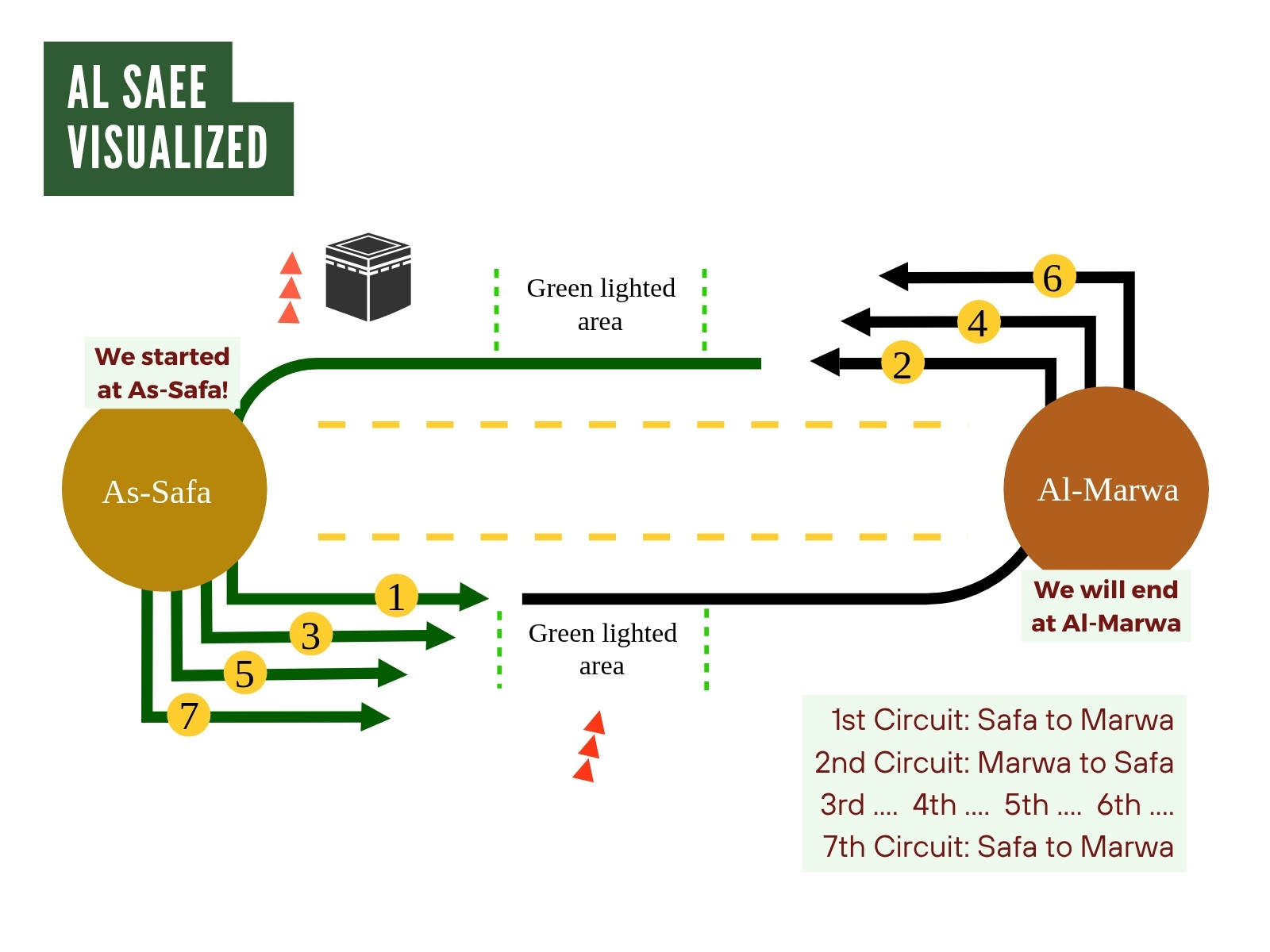
From the Arabic saʿā — to pursue, walk, or strive. Walk seven lengths between the hills of Safa and Marwah, starting at Safa.
Wudu recommended — not required (unlike Tawaf)
Start at Safa — face Kaʿbah, say takbeer dua 3× + personal du'a after each
Men only: run between the green lights
Walk to Marwah = 1 circuit · 7 total · end at Marwah
Wudu
Wudu is recommended but not required for Sa'i. Wudu is required for Tawaf.
Innaṣ-Ṣafā wal-Marwata min shaʿāʾirillāh, faman ḥajjal-bayta awiʿtamara falā junāḥa ʿalayhi an yaṭṭawwafa bihimā, wa man taṭawwaʿa khayran fa-innallāha shākirun ʿalīm.
Behold! Safa and Marwah are among the symbols of Allah. So whoever visits the House for Hajj or Umrah, there is no sin in walking between them. And whoever does good willingly — Allah is Appreciative, All-Knowing. (Qur'an 2:158)
Approaching Safa
When you reach the hill of Safa, say:
نَبْدَأُ بِمَا بَدَأَ اللَّهُ بِه
Nabdaʾu bimā badaʾAllāhu bihi
We begin with what Allah began with.
Why this dua makes sense
After Maqam Ibrahim, Marwah is closer. Going there first would be easier — but Allah named Safa first in the verse, so we begin where He began.
Sa'i corridor · Safa → Marwah · 7 lengths · men run between the green lights
At Safa Hill
Climb (or walk up) Safa, stand in the designated area
Face the Kaʿbah (signs show direction)
Say this dua 3 times, making personal du'a after each:
Allāhu Akbar, Allāhu Akbar, Allāhu Akbar. Lā ilāha illAllāh waḥdahu lā sharīka lah, lahul-mulku wa lahul-ḥamd, yuḥyī wa yumītu wa huwa ʿalā kulli shayʾin qadīr. Lā ilāha illAllāh waḥdah, anjaza waʿdah, wa naṣara ʿabdah, wa hazamal-aḥzāba waḥdah.
None has the right to be worshipped except Allah alone, without partner. To Him belongs all sovereignty and praise; He gives life and causes death and He is over all things omnipotent. None has the right to be worshipped except Allah alone — He fulfilled His promise, aided His servant, and single-handedly defeated the allies.
Safa → Marwah
Descend Safa, walk toward Marwah
Men only: at the first set of green lights, run quickly until the second set
No specific du'a required between the greens — companions used to say:
Need a break?
Sa'i does not have to be done in one stretch. If you need to rest, use the bathroom, or step out — resume from where you left off, not from circuit 1. Sa'i has no time limit either.
Step 06
Halq / Taqsir
حَلْق / تَقْصِير
Wajib · Final Rite
Shave or Trim · Exit Ihram
After Sa'i, the final wajib is to shave (halq) or trim (taqsir) the hair. Once done — your Umrah is complete and you exit ihram.
Men: shave entire head (preferred · more reward) or trim ~fingertip length all over
Women: gather hair, cut ~fingertip length (~1cm) from ends · do this in your room
After cutting — Umrah complete. Exit ihram. All restrictions lifted.
For Men · Two Options
Halq — shaving the head completely. Preferred, more reward.
The Prophet ﷺ said: "May Allah have mercy on those who shave their heads." He repeated it three times. When asked about those who trim, he said: "And those who trim."
Taqsir — trimming. Cut from all areas of the head (not just sides), approximately a fingertip length.
Where
Many barber shops in and around the hotel · brothers can go together as a group. You can also shave yourself in your hotel room — bring a trimmer from home if you prefer privacy and speed.
For Women
Gather hair together; cut approximately a fingertip length (~1 cm / half inch) from the ends
Tie hair into a braid and cut straight across the ends
Can be done yourself or with a roommate's help
Do this in your hotel room
Umrah Mubarakah
After cutting, your Umrah is complete. You are released from all ihram restrictions and return to the state of ḥil. May Allah accept from you.
Final Recap — Umrah Mabroorah!
Pillars · Wajibat · Sunan — may Allah accept from youعُمْرَة مَبْرُورَة